


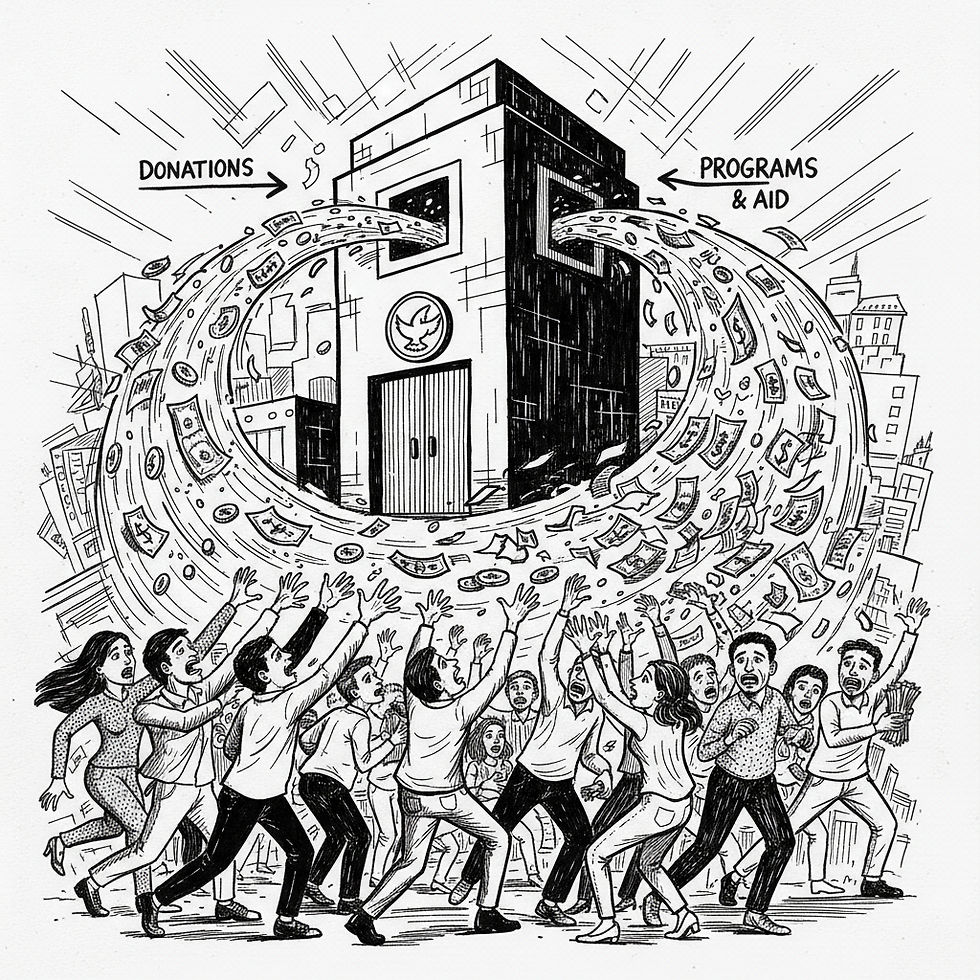
What if the nonprofit sector is part of our economic infrastructure?

In my October 9, 2026 post, I shared what stuck with me after hearing Robert Egger speak: what if we stopped chasing money and started chasing the mission? One question has been following me around ever since. If charity is not the end goal, what exactly is the nonprofit sector for?
A recent piece from Charity Bridge Fund offers one answer, and I find it both challenging and hopeful. It argues that nonprofits are not only a safety net. They are part of the engine that keeps our economy steady. I wanted to test that idea, so I looked at the underlying data.
How big is the nonprofit sector, really?
The numbers surprised me. According to the Bureau of Labor Statistics, more than 300,000 nonprofit establishments accounted for 12.8 million jobs in 2022, or 9.9 percent of all private-sector jobs. That is roughly one out of every ten paid jobs in the private economy.

Nearly two out of three of those jobs, 66.3 percent, were in health care and social assistance. The concentration varies by place, too. Nonprofit jobs made up 25 percent of all
employment in Washington, D.C., 20 percent in Vermont, and 18 percent in Massachusetts.
Charity Bridge Fund stresses that these are paid positions, with employees who earn wages, pay payroll taxes, and spend their income in the same communities they serve. The BLS figures run through 2022 and are updated every five years, so they are a snapshot rather than a live feed.
What does it mean to call services infrastructure?
We rarely ask whether a bridge is charity. We simply recognize that people and goods need it to get where they are going. Charity Bridge Fund argues that food assistance, health care, and housing work the same way, because they help people stay healthy, housed, and able to work. Three examples stood out to me.
Take food assistance. SNAP is a federal program, and nonprofits work in the same space with the same aim of keeping households steady. The USDA Economic Research Service describes SNAP as an automatic stabilizer that expands when the economy weakens. It estimates that a $1 billion increase in benefits raises GDP by $1.54 billion and supports 13,560 additional jobs during a slowing economy.
Then consider health care. HRSA-funded health centers served more than 31 million patients in 2023, and over 90 percent of those patients had incomes below 200 percent of the federal poverty guidelines. Charity Bridge Fund notes that community health centers are often nonprofits that provide preventive care, chronic disease management, and mental health services.
Finally, housing. The article makes the case that without stable housing, employment becomes fragile, and that eviction prevention and rental assistance help families weather a temporary shock without losing their jobs.
Where does Egger fit into this?
This framing helped me see Egger's work in a new light. DC Central Kitchen took wasted food, turned it into meals, and trained jobless adults in the culinary arts. Long before anyone called it economic infrastructure, Egger was building it: feeding people while preparing them for paying work.
He has said we need to move beyond a 19th-century concept of charity, and he tied the fight against hunger to job training, housing, health care, and education. Read side by side, the two ideas fit together. Egger asks us to measure ourselves by how much need we eliminate. Charity Bridge Fund suggests that part of that answer shows up in the economy, because people who are fed, healthy, and housed can work, spend, and contribute.
What might change in how we talk about our work?
I think this reframing is useful, and I also think it deserves a careful look. Economic estimates carry assumptions. The ERS multiplier applies to a slowing economy, and the BLS nonprofit figures describe 2022. These numbers are a strong starting point for a conversation rather than the end of one.
The language matters, too. Kendall Webb, founder of Charity Bridge Fund, sums up the argument by saying that this work is not charity at all but economic stabilization. I would add that the mission still comes first. If we describe our work only in dollars, we risk drifting from the reason we do it. But if we can speak both languages, the mission and the math, we may reach people who have not yet seen themselves as part of the story: employers, elected officials, and the service clubs I talk with every month.
My invitation: count the whole picture
Here are a few ways to try this idea on for size.
Tally your organization's economic footprint: jobs, wages, local purchases, and the people your programs help stay in school or at work.
Share the 12.8 million figure with a business leader or elected official, and ask what number they would have guessed.
Invite a local employer or service club to see your work firsthand, and let them draw the connection themselves.
This loops back to my soapbox, too. When service clubs show up for nonprofits instead of competing with them, they are investing in the same local economy that supports their members' businesses.
So I will leave you with a few questions. If nonprofits are part of our economic infrastructure, how should we talk about them and fund them? What might change in your community if more people saw a food pantry or a health clinic the way they see a bridge? And what is one number about your own organization's impact that you could share this month?
I would love to hear your thoughts. You can find me on social media @YourMissionMaven
References
Charity Bridge Fund. The nonprofit sector: an engine driving economic stability.
U.S. Bureau of Labor Statistics. Nonprofit sector research data.
USDA Economic Research Service. Supplemental Nutrition Assistance Program (SNAP): key statistics and research.
Health Resources and Services Administration. New data show highest number of health center patients in nearly 60 year history of the program.
DC Central Kitchen. Mission and history.
Ink-andescent. DC Central Kitchen founder Robert Egger is "Begging for Change".
Ink-andescent Publishing. Begging for Change.
Your Mission Maven. What if we stopped chasing money and started chasing the mission?


Comments